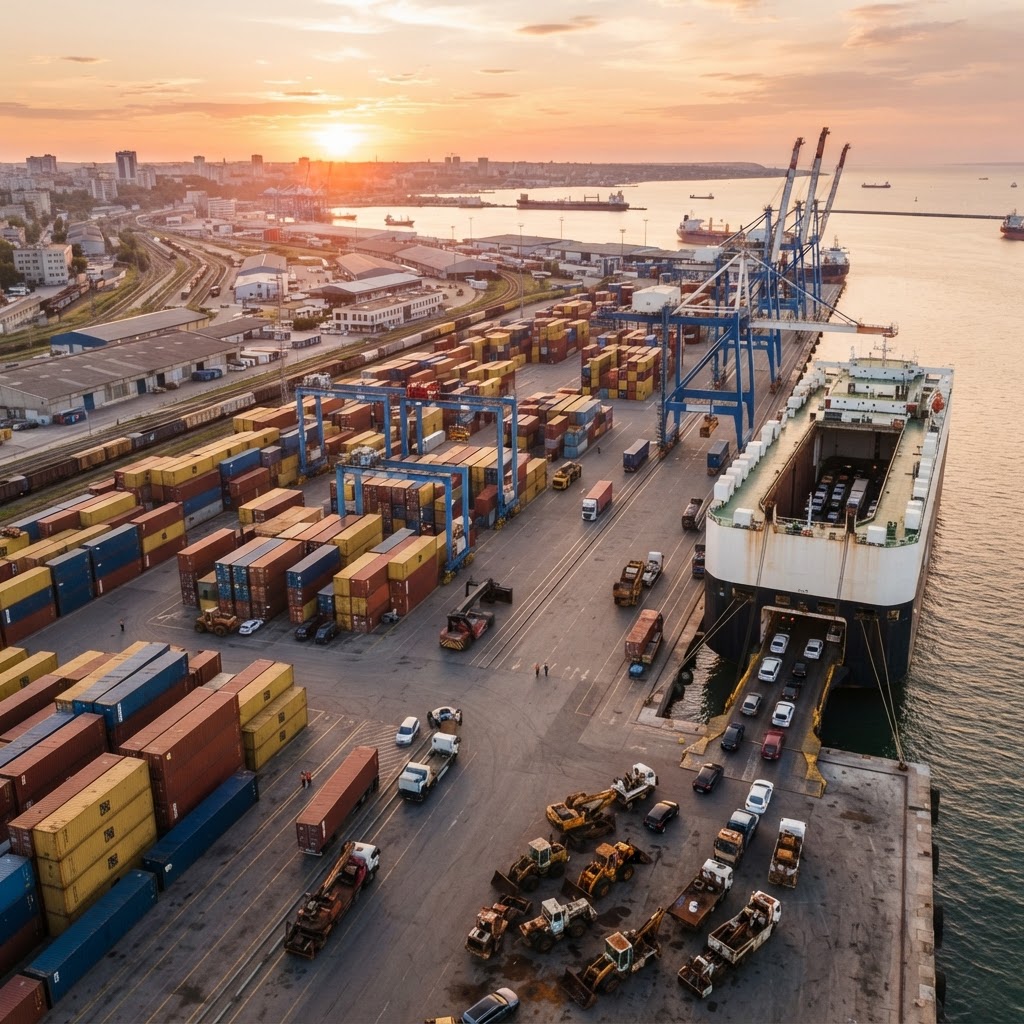
Why Logistics Matters More Than the Winning Bid
Winning the auction is only the first 20% of the work. For international buyers, the real challenge — and the real cost — begins the moment the auctioneer's hammer falls. Shipping a salvage vehicle from a US auction lot to a port in your country involves title processing, inland transport, ocean freight, customs clearance, and local registration. Each step has its own timeline, paperwork, and potential for costly delays.
This guide walks through the entire process end to end, so you can budget accurately, avoid common pitfalls, and understand exactly what happens between the day you win a bid and the day the car arrives at your door.
Step 1: Auction Payment and Title Processing
After you win a vehicle at Copart or IAAI, the clock starts immediately. You typically have 3 business days to pay the full invoice, which includes the final bid price, auction fees, and any gate fees. Late payment triggers storage fees of $25–$75 per day, which add up fast.
Once paid, the auction begins processing the title. This is where many international buyers lose time:
- Clean title vehicles: The auction receives the title from the seller and reassigns it. This takes 7–14 business days.
- Salvage and rebuilt titles: Similar timeline, but some states require additional processing.
- Certificate of Destruction / Junk titles: These cannot be reassigned for road use. The auction issues a bill of sale and the vehicle is flagged for export only. Processing is often faster (5–10 days) because no title reassignment is needed.
Important: A vehicle cannot leave the auction yard until the title or bill of sale is ready. Budget at least two weeks of waiting here, and do not book ocean freight until you have confirmation that the paperwork is processed.
Step 2: Choosing Your Exit Port
US salvage vehicles are shipped from a handful of major export ports. The port you choose depends on where the vehicle is located and where it is going:
- East Coast — Newark, NJ / Baltimore, MD / Savannah, GA / Jacksonville, FL: Best for vehicles sourced east of the Mississippi and for shipments to Europe, West Africa, and the Middle East.
- Gulf Coast — Galveston, TX / Houston, TX / Jacksonville, FL: Ideal for vehicles from Texas and the South, serving Central America, the Caribbean, and West Africa.
- West Coast — Long Beach, CA / Tacoma, WA: The route for vehicles from the western US, serving Asia, Oceania, and the Pacific.
Your shipping broker will usually recommend the closest port to the auction yard to minimize inland transport costs. Inland trucking from the auction to the port runs $200–$800 depending on distance, and adds 3–7 days to the timeline.
Step 3: Container vs. RoRo — Choosing the Right Shipping Method
There are two main ways to ship a vehicle across the ocean, and the choice affects cost, safety, and flexibility.
Roll-on/Roll-off (RoRo)
The vehicle is driven onto a specialized car carrier ship and driven off at the destination port. RoRo is the cheaper option for a single vehicle — typically $1,200–$2,500 depending on the route — and faster to load. However, RoRo has strict requirements:
- The vehicle must roll and steer. A "Does Not Run" salvage car cannot go on RoRo without a surcharge for a forklift, and some lines refuse non-running vehicles entirely.
- No personal items or spare parts can be loaded inside the car.
- RoRo ships sail on fixed schedules to major ports only — your destination port options are limited.
Container Shipping
The vehicle is loaded into a 20-foot or 40-foot shipping container and secured. Container shipping costs more for a single car — $1,800–$3,500 for a 20ft container — but offers major advantages for salvage buyers:
- Non-running vehicles are welcome. The car can be winched into the container, so "Does Not Run" and "Starts" condition vehicles are no problem.
- You can load parts. Many buyers fill the container with spare parts, engines, or even a second vehicle. A 40ft container fits 3–4 sedans, making the per-vehicle cost competitive for volume buyers.
- More destination ports. Containers reach far more ports than RoRo ships.
- Better protection. The vehicle is sealed inside a container, protected from weather and handling damage.
Recommendation: For most salvage vehicles — especially non-running, flood, or rollover damage cars — container shipping is the safer and more flexible choice despite the higher base cost.
Step 4: Required Export Paperwork
To legally export a vehicle from the United States, you need the following documents in order:
- Title or Bill of Sale: The original title (for clean/salvage/rebuilt) or bill of sale (for destruction/junk titles) from the auction.
- Bill of Lading: Issued by the shipping line once the vehicle is loaded. This is your proof of shipment and your claim ticket at the destination port.
- Export declaration (EEI / AES filing): Required for vehicles valued above $2,500. Your shipping broker or freight forwarder files this electronically with US Customs.
- EPA and DOT forms: For export, these are generally straightforward — the vehicle is leaving the US, not entering it. Your broker handles the standard export exemption paperwork.
- Commercial invoice / packing list: Shows the vehicle details, VIN, and value for customs at the destination.
A reputable freight forwarder handles all of this on your behalf. Never attempt to export a vehicle without a licensed forwarder — paperwork errors can result in the vehicle being held at port for weeks.
Step 5: Ocean Freight and Transit Times
Once loaded, ocean transit times depend entirely on the route:
- US East Coast → Western Europe: 10–18 days
- US East Coast → West Africa: 18–28 days
- US East Coast → Middle East (Jebel Ali, Bandar Abbas): 25–35 days
- US Gulf Coast → Central America / Caribbean: 7–14 days
- US West Coast → East Asia: 14–22 days
- US West Coast → Oceania: 20–30 days
- US East Coast → Central Asia (via Europe + overland): 35–50 days
These are vessel transit times only. Add 5–10 days for port handling on each end, customs clearance, and inland delivery to your final destination.
Step 6: Customs, Duties, and Taxes at Destination
This is where the cost structure changes dramatically depending on your country. Every nation taxes vehicle imports differently. The key figures to know before you bid:
- Import duty: A percentage of the vehicle's CIF value (Cost + Insurance + Freight). Ranges from 0% in some free-trade zones to 50%+ in markets with heavy protection.
- VAT / GST: Many countries add a value-added tax on top of duty, often 15–20%.
- Excise tax: Some countries tax based on engine displacement or vehicle age — older and larger-engine vehicles pay more.
- Registration and inspection fees: Paid after customs clearance to make the vehicle road-legal.
Example: A vehicle with a CIF value of $8,000 landing in a country with 30% duty and 18% VAT pays $2,400 in duty plus $1,476 in VAT — adding $3,876 to the landed cost before registration. Always calculate this before bidding, not after.
Use the BiddCars customs duty calculator on any vehicle page to estimate landed costs for your destination before you commit to a purchase.
Step 7: Salvage Title Restrictions — Know Before You Ship
Not every salvage vehicle can be imported into every country. Title brands affect what you can do with the car after it arrives:
- Salvage / Rebuilt titles: Most countries allow import but require a local inspection before registration. Some require a full roadworthiness test.
- Flood title: Some countries restrict or ban flood-branded vehicles entirely. Check local rules.
- Certificate of Destruction / Junk: These vehicles are for parts or scrap only. They generally cannot be registered for road use in any country, but may be imported for dismantling.
If your goal is to rebuild and drive the car, verify your country's rules on US salvage titles before bidding. If your goal is parts or export to a market with flexible titling, destruction-title vehicles are often the cheapest option.
Step 8: Realistic Total Cost Breakdown
Here is a realistic budget for importing a mid-size salvage sedan from a US East Coast auction to a Central Asian or Middle Eastern destination:
- Winning bid: $6,000
- Auction fees: $600
- Inland transport to port: $400
- Container shipping (20ft): $2,200
- Marine insurance: $80
- Destination port handling: $350
- Customs duty (30% of CIF ~$8,280): $2,484
- VAT (18%): $1,937
- Customs broker fee: $200
- Local registration and inspection: $400
Total landed cost: ~$14,651 — more than double the winning bid. This is normal. The bid price is only the beginning; a buyer who budgets only the auction price will be surprised every time.
Step 9: Total Timeline — Bid to Driveway
A realistic end-to-end timeline for an international salvage import:
- Auction payment + title processing: 2–3 weeks
- Inland transport to port: 1 week
- Port loading + vessel departure: 1–2 weeks (depends on sailing schedule)
- Ocean transit: 2–5 weeks (route dependent)
- Destination port handling + customs: 1–2 weeks
- Local registration: 1–2 weeks
Plan on 8–12 weeks from the day you win the bid to the day the car is registered in your country. Delays in title processing, missed sailing schedules, and customs holds can push this to 14 weeks. Build that expectation into your planning.
How BiddCars Helps with the Process
BiddCars is built to make the front end of this process transparent. Before you ever place a bid:
- Full auction records for every vehicle show damage type, condition, title status, sale price, and location — so you can evaluate whether a car is worth the logistics cost.
- Free VIN decode shows manufacturer specs and open recalls so you know exactly what you are buying.
- Freight and customs duty calculators on every vehicle page estimate shipping and landed costs for your destination.
- Container tracking lets you follow your shipment once it is on the water.
Win the right vehicle, budget the full landed cost, work with a licensed freight forwarder, and plan for a 2–3 month process. Do that, and importing a salvage car from US auctions becomes a predictable, manageable operation rather than a gamble.
Looking for a specific salvage vehicle? Search our auction database by VIN, make, or model.
Search Auction Vehicles